What is The Degumming Process in Oil Refining Plants?
The degumming process in an oil refining plant is to remove gum impurities in crude oil by physical or chemical methods, and it is an oil purification process. After screw pressing and solvent extraction from oilseeds, crude oil mainly contains triglycerides and a few non-triglyceride. The non-triglyceride composition including phospholipids, proteins, phlegmatic, and sugar would react with triglycerides to form colloids, which are known as gum impurities.

The gum impurities not only affect the stability of the oil but also affect the process effect of oil refining and deep processing. For instance, non-degummed oil is easy to forms an emulsified oil in the alkaline refining process, thus increasing the difficulty of operation, oil refining loss, and auxiliary material consumption; in the decolorization process, non-degummed oil will increase the consumption of adsorbent and reduce discoloring effectiveness. Therefore, gum removal is necessary as the first step in the oil refinery process before oil deacidification, oil decolorization, and oil deodorization.
Degumming Method: Hydrated degumming
The specific methods of degumming include hydrated degumming, acid refining degumming, alkali refining method, adsorption method, electropolymerization, and thermal polymerization method. In the edible oil refining process, the most commonly used method is hydrated degumming, which can extract the hydratable phospholipids and some non-hydrate phospholipids, the remaining non-hydrate phospholipids need to be removed by acid refining degumming.
1. Working principle of hydrated degumming
The gum impurities such as phospholipids have the characteristic of hydrophilic. First of all, you can stir and add a certain amount of hot water or electrolyte aqueous solution like salt & phosphoric acid to the hot crude oil. After a certain reaction period, the gum impurities would be condensed, subsided, and removed from the oil. In the hydrated degumming process, the impurities are mainly phospholipid, as well as a few proteins, glyceryl diglyceride, and mucilage. What’s more, the extracted gums could be processed into lecithin for food, animal feed, or technical uses.
2. Hydrated degumming process
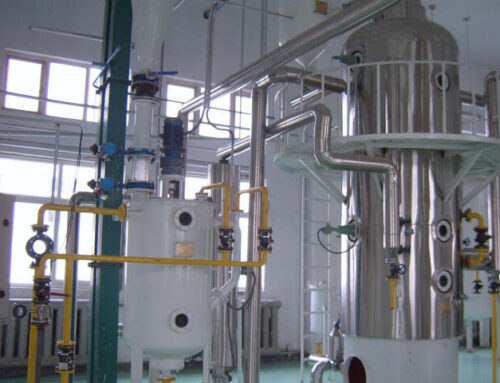
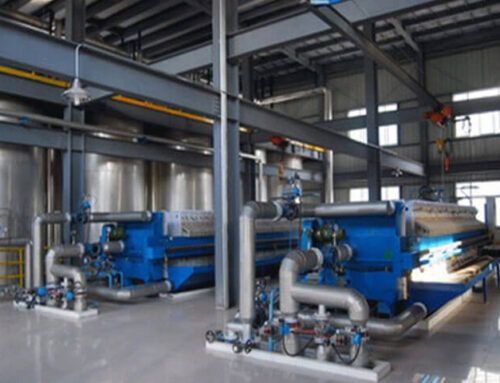
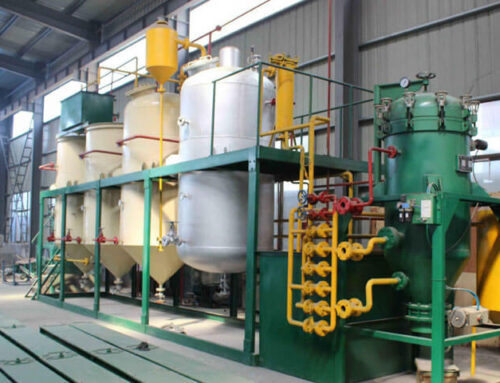
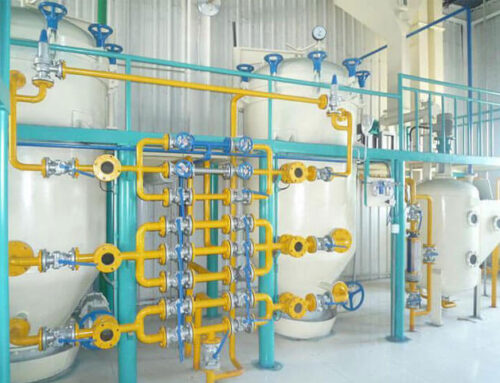
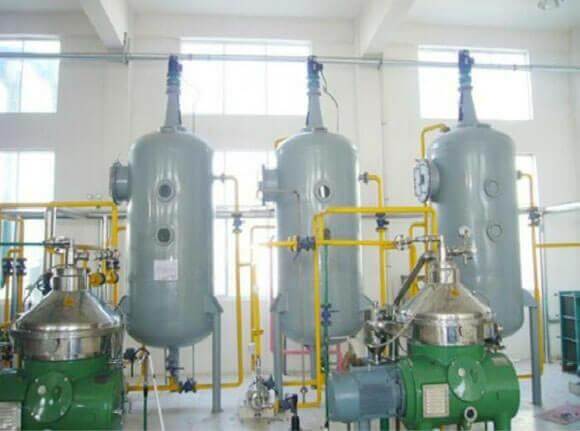
In an oil refining plant, the hydrated degumming machine can be operated together with oil deacidification machine, decolorization machine, and deodorizing machine, and these machines are the composition of the oil purifying production line. The purifying line is classified into intermittent type, semi-continuous type, and fully continuous type. The customer could choose the type according to their required production capacity: the factory with a production capacity of 1-10t per day is suitable for using intermittent type equipment, 20-50t per day factory is suitable for using semi-continuous type equipment, producing more than 50t per day is suitable for using fully continuous type equipment. The most commonly used type is the intermittent hydrated degumming production line.

3. Intermittent Hydrated Degumming Process
3.1 Steps in intermittent hydrated degumming process
3.1.1 High-temperature hydration method:
It is suitable for degumming soybean oil with high gum content.
- First of all, heat the crude oil to around 80℃.
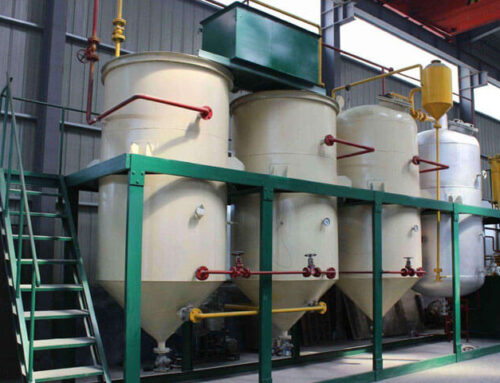
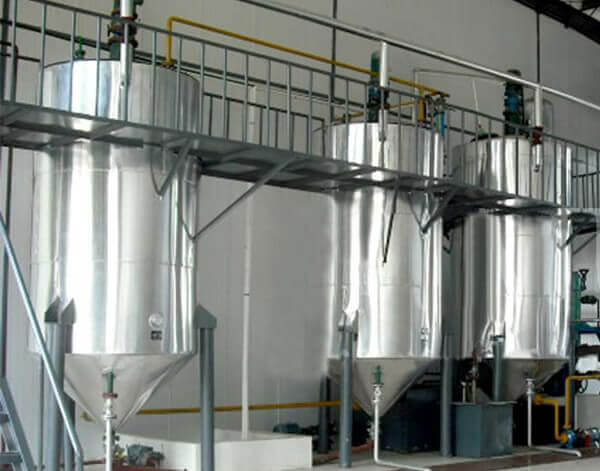
- Next, add water to the crude oil at the water-gum ratio of 3.5:1 and mix them thoroughly for 30 minutes in hydration tank. Hydration tank is the main degumming machine for intermittent degumming flocculation, it is made up of tubular, heating device, mixing device and conveying pipe, which has the similar structure with the settling tank for sedimentation and separation of the hydration oil foot. Considering the turnover of production, factory’s director will at least purchase two hydration tanks and the hydration tank can be used as the settling tank. Hydration tank has the features of simple structure, strong suitability, and easy operation.

- When the oil-water mixture begins to generate flocculate, keep the temperature at 80℃ and let the flocculate settled thoroughly for 5-8 hours. Then, the upper clean oil is separated and pumped to vacuum dryer for dehydrating, and the oil feet in the bottom is sent to the salting tank for recovering oil again or could be concentrated into lecithin for food, animal feed or for technical purposes.
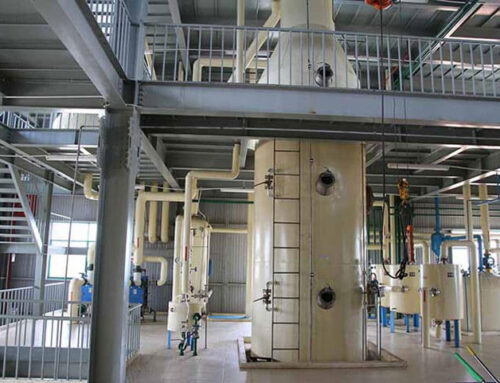
- After separating from gum impurities, the degummed oil still contains 0.3%~0.6% moisture, which could be removed in a vacuum dryer at the temperature of 100℃-105℃ and the vacuum degree is between 680-700mmHg. The vacuum dryer is equipped with a spraying device, vacuum system, external heating system and stirring cycle device, it has the features of small size and continuous operation.

- Please note, if residue solvent is included in solvent extracted oil, it needs to be removed by desolventizer for the last purification. Then, the degummed oil will be conveyed to the process of next.
3.1.2 Medium temperature hydration:
It is suitable for degumming peanut oil. The hydration temperature is 60~65℃, and the amount of added water is 2~3 times as much as the gum content. After hydration, the oil-water mixture’s settling time is at least 6 hours. Then, the degummed oil would be through dehydrating or desolventizing for the final purification.
3.1.3 Low-temperature hydration:
It is suitable for degumming oil with low gum content in small oil refining factory, the hydration temperature is 20~30℃ and the amount of added water is 0.5 times as much as the gum content. After hydration, the oil-water mixture’s settling time is at least 10 hours.
3.2 Hydrated degumming’s process points
3.2.1 Volume of added water
(1) Effect of added water on flocculation:
A proper amount of water can form a stable multi-layer liposome structure. Insufficient water will lead to incomplete hydration and bad colloidal flocculation; Excessive water tends to form water-oil emulsification, which makes it difficult to separate impurities from the oil.
(2) The relationship between added water content (W) and glum content (G) in different operating temperatures:
| low temperature hydration(20~30℃) | W=(0.5~1)G |
| medium temperature hydration(60~65℃) | W=(2~3)G |
| high temperature hydration(85~95℃) | W=(3~3.5)G |
(3) Sample test: An appropriate amount of added water can be determined through a sample test.
3.2.2 Operating temperature
The operation temperature is generally corresponding to the critical temperature (for better flocculation, operation temperature can be slightly higher than the critical temperature). The operation temperature will affect the amount of added water when the temperature is high, the amount of water is large, otherwise, it is small.
3.2.3 Intensity of hydration mixing and reaction time
(1) Inhomogeneous hydration
Gum flocculation is a heterogeneous reaction at the interaction interface. In order to form a stable oil-water emulsion state, mechanical mixing the mixture can make the droplets fully dispersed, mechanical mixing needs to be intensified especially when the amount of added water is large and the temperature is low.
(2) Intensity of hydration mixing
When mixing oil with water, the stirring speed is 60 r/min. At the period of flocculation generating, the stirring speed is 30 r/min. The reaction time of hydration mixing is around 30 minutes.
3.2.4 Electrolytes
(1) Varieties of electrolytes:
Salt, alum, sodium silicate, phosphoric acid, citric acid, and dilute sodium hydroxide solution.
(2) The main function of electrolyte
1. Electrolytes can neutralize some electric charge of colloidal particles and promote the colloidal particles to sedimentate.
2. To convert the non-hydrated phospholipids to hydrated phospholipids.
3. Alum: flocculant aid. Alum can absorb pigments in oil.
4. To chelate with metal ions and remove them.
5. To promote the colloidal flocculation closer and reduce the oil content of flocs.
3.2.5 Other factors
(1)uniformity of oil:
Before hydration, the crude oil should be fully stirred so that the colloid can be distributed evenly.
(2)temperature of added water
When hydration, the temperature of adding water should be equal to or slightly higher than the oil temperature.
(3)added water quality
(4)operational stability
Customer-made Degumming Equipment in The Cooking Oil Industry
Generally speaking, the technical parameters of the degumming process are determined according to the quality of the oil, and the parameters of different oils in the degumming process are different. If you have an interest in refining oil, please contact us with your questions or ideas. We will arrange for our professional engineers to customize a suitable oil line equipped with the corresponding oil refining equipment for you. For example, successful cases of oil degumming have been used in soybean oil production plants, peanut oil production lines, palm kernel oil plants, and sesame oil refining plants.